
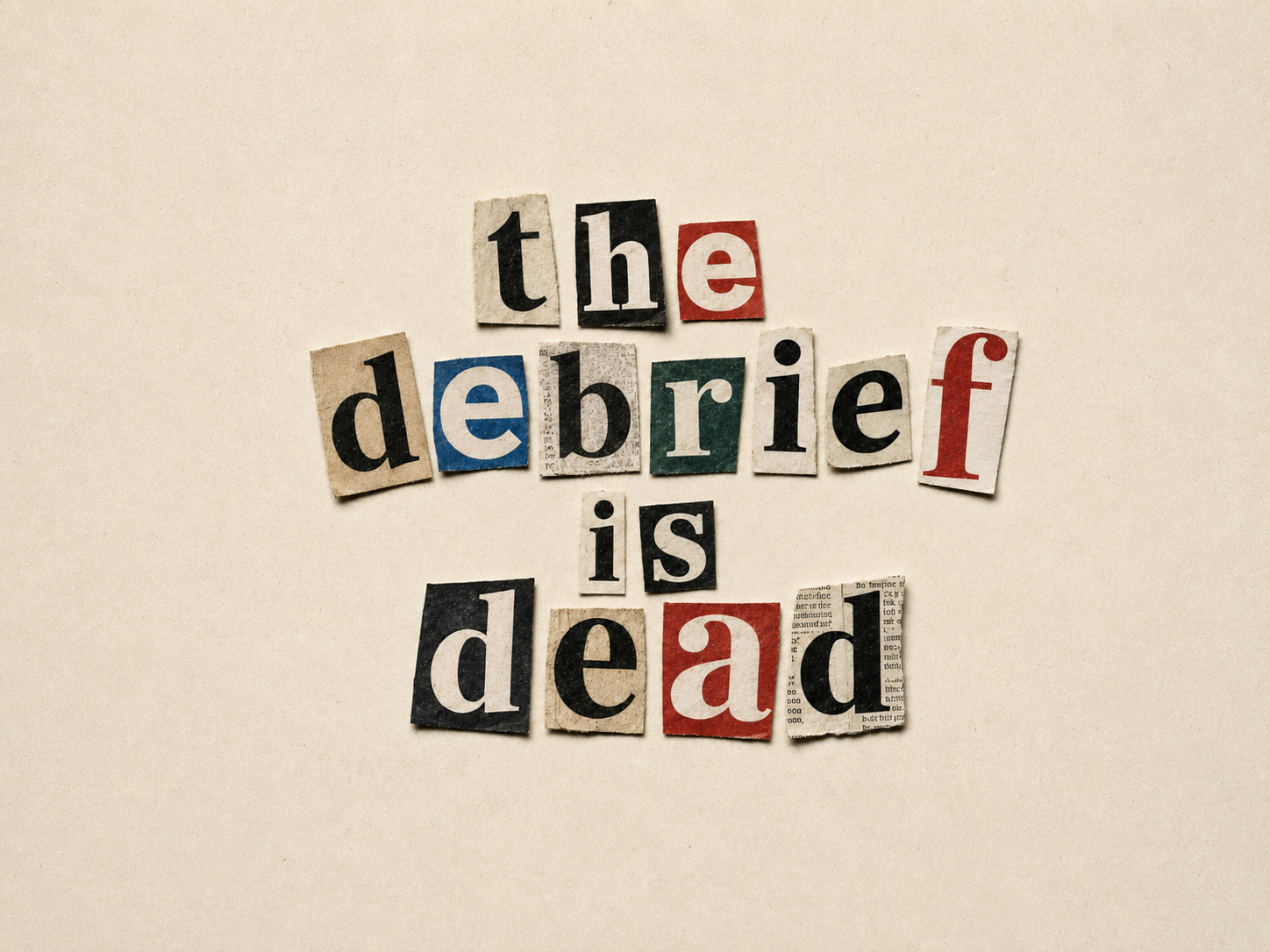
The Debrief is Dead.
I’ve been on both sides of “the deck”.
Agency side,I’ve stayed late finishing debriefs, I’ve connected the dots, trimmed the fat and made clean recommendations. I’ve presented. I’ve watched the nods. I’ve heard [genuine] praise. But then nothing happens. Nothing changes, and nothing is implemented.
In-house, I’ve been the one receiving those decks and I know where lots of them go. They go onto a shared drive, into a folder nobody opens, next to last year’s report that also went nowhere. I’ve seen genuinely good thinking become just noise, not because it was wrong or lacked quality, but because nobody was ever set up to act on it.
Research is optimised for the ah-ha moment but ignores the now-what. And if the work I spend hours on just sits on a server, my job starts to feel rather pointless.
So, here’s my argument: the debrief, as we know it, needs to die. Not the rigour behind it. The ritual.
The debrief was designed to end a project, not to start a change
Think about the format. A meeting. A deck. A presenter talking at a room. A polite Q&A. A “thanks, really useful.” It’s a handover; the moment the agency stops being responsible and the client is left holding a PowerPoint.
A handover assumes the receiving side knows what to do next. But the C-suite wasn’t in the room when the questions were shaped, so they never bought into the answers. The insight team nods along in an echo chamber of people who already agree. And the people who actually need to change their behaviour - the ones in proposition, media, product, customer experience or the boardroom - were never part of the process at all. You can’t parachute a conclusion into an organisation that didn’t help build it and expect it to take root.
The problem is only becoming more obvious. Today, AI can surface patterns faster than any team of humans ever could. It can synthesise information, explore possibilities and accelerate analysis at a scale that was unimaginable a few years ago. But intelligence is no longer the bottleneck. The bottleneck is deciding what to do with it.
Human judgement, context, experience and strategic thinking still matter. Arguably, they matter more than ever. Because in a world where intelligence is increasingly abundant, competitive advantage comes from how effectively you act on it.
Stop asking “what did we find?” Start asking “what will we do?”
This is the shift. Before a single chart gets made, ask: what decision is this meant to unblock? That one question changes everything downstream. It tells you who needs to be involved (the decision-maker, not just the insight lead). It tells you what the output should be (a choice, not a summary). And it tells you when the work is finished; not when the deck is sent, but when something moves. Research shouldn’t culminate in a presentation. It should culminate in a decision. Or better still, a series of decisions that create momentum.
So, here’s three ways I / we are rebuilding the debrief
1. Activate intelligence, don’t present insight
The best debrief I ever ran had no debrief. We put the core findings on the wall and spent the next few hours in a room with decision-makers exploring what those findings actually meant. Not reviewing the data. Interrogating the implications. We connected the intelligence to the strategic choices facing the business. The goal wasn’t alignment on the findings; it was alignment on what happens next. By the end, there was ownership of next steps. That’s the difference.
2. Make the intelligence do something, not just say something
A finding that “younger buyers distrust the category” is interesting, but a roadmap for winning them back is valuable. The gap between the finding and the roadmap is where most research falls down. Too often, we stop at insight generation when the real opportunity lies in translating what we’ve learned into strategic implications and practical action. Wherever possible, don’t just show people the door. Walk them through it.
3. Hand over a decision, not a document
End every project with the smallest possible set of clear choices. Here’s what this means. Here are the implications. Here are the actions available to you. And here’s the one I’d implement first. Researchers are often nervous about being this directive. But clients aren’t paying for neutrality. They’re paying for clarity, perspective, and confidence in what happens next. The report isn’t where the value lies. The decision is.
Research that informs is table stakes. Research that activates, that changes a decision, a roadmap, a behaviour or a business direction, is the job. And that doesn’t happen by accident at the end of a project. It’s designed in from the start.
We Live Context, think about this as a simple progression.
· Here’s what. The intelligence. The evidence. The insight.
· So what. The strategic implication. Why it matters. What changes because of it.
· Now what. The action. The decision. The next move.
Most research is still focused on the first part. Good strategy reaches the second. Real impact happens at the third. Our deliverable was never the report. It’s the change. If your insight is sitting on a shared drive, the problem probably wasn’t the insight. It’s that the debrief was treated as the finish line, when it should have been the starting gun.